Keith Judy wasn't letting go, no matter how long the play stretched on.
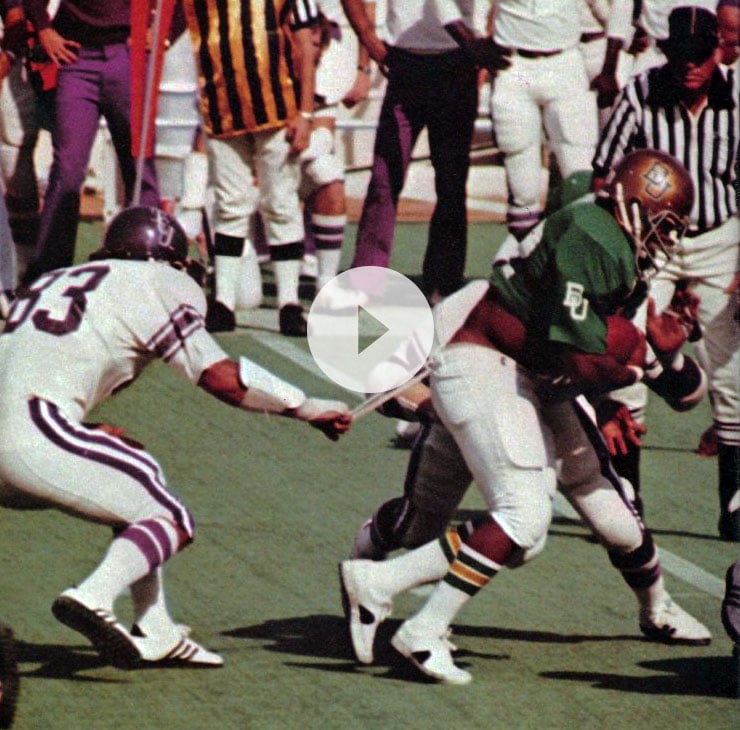
When you walk into Keith’s Datamax Longview office, as you turn away from his desk, the TCU football photo on the wall appropriately commemorates his playing days. At the same time, you don't notice anything memorable... until you look a little closer. It usually takes folks four or five seconds to realize that the perfectly-timed shot captures not only a signature moment of his four-year TCU football career. It serves up some great comic relief.
The photo on Keith's wall is, at the very least, nothing short of a conversation piece.
It was a picturesque, sunny-yet-pleasant fall afternoon in Waco, the first of November, 1975. The kind of Saturday weather that Texans wait six months for. The annual “Revivalry” game between Keith’s TCU Horned Frogs and the Baylor Bears trickled down through the second quarter, and his Frogs were down. Again. Judy, situated at outside linebacker, approached the line of scrimmage to wait for the snap. The ball went into motion, and Keith, head on a swivel, almost immediately noticed it being handed off to the tailback coming over the tackle opposite of him.
“I froze for a second, he didn’t come my way, so I just ran down the line as fast as I could, grabbing anything I could. I reached for his jersey (and missed), but ended up trying to grab the back of his pants.”
What he grabbed instead was the running back’s athletic supporter. The running back sluggishly trudged forward like a bridled horse, dragging Keith and his mighty grip several yards behind him. By whatever means necessary, Keith was determined to make a play.
“I just held on to it. I didn’t realize what I had until that thing stretched. By the time the play was over, it was stretched out six feet or so. Once we got him on the ground, it shot right back at him like a rubber band.”
A sideline photographer captured the play perfectly. And the photo – the same one that hangs in Judy’s office – ended up on the front page of the Fort Worth Star Telegram the next morning.
“I’ve kind of been known for that play ever since,” Judy said. “I wasn’t letting go.”
Enduring a game that is as brutal as it is competitive, Keith, playing primarily defensive end, learned a lot about himself in his four years on the college football stage. He learned about getting back up, over and over again. He learned about getting himself mentally ready when opportunities presented themselves.
But he also gained an intimate understanding and respect for the invaluable aspect of "team."
“In football, every single position is important. Everybody (on the field) has an assignment. Mine was to not let an offensive player get outside of me,” Keith said. “But everyone on our defense had their own responsibilities. If everyone does what they need to do with the assignments, hopefully you’ll be successful in stopping the offense.”
Getting Back Up Matters
Keith was knocked out three times in his career. Playing against Arkansas in 1975, he was rattled so hard his helmet cracked from the ear hole all the way to the top of the helmet. Keith got back up, switched out helmets on the sideline, but never missed a play.
"Although, I don't remember what the locker rooms looked like (later)," he said.
Against A&M the same season, he got hit in the head by an offensive lineman, and though he didn't realize the extent of the blow initially, what happened next became a blur.
“The middle linebacker came into the huddle, and he called a play I know he’s called 1,000 times before. But I had no idea what it meant,” Keith said.
“That night was just excruciating,” Keith said. “I had the headache of my life. Pretty much incapacitated.”
Equally brutal was TCU’s schedule. Situated into the thick of the heavyweight Southwest Conference, TCU was offered no “gimmies” in 1974 or 1975. His junior year, the Horned Frogs played at No. 11 Arizona State, at No. 20 Arkansas, at No. 8 Texas A&M, at No. 4 Alabama and at No. 19 Texas Tech.
The following year? They played the No. 4, 5, 6, and 7th nationally ranked teams, including another trip to Alabama.
"It was just tough football. Texas had just won the national championship a few years previous. Every game in the Southwest Conference was tough," Keith said. " Playing in Birmingham at Legion Field against Alabama was one of my fondest memories. Bear Bryant was there. The Alabama people were all really great to us. And hey, we hung in there with them a little while."
The Horned Frogs in '74 and '75 won a collective two games in the two seasons Judy started. But he and the team perservered, knowing they had a unique opportunity every Saturday. And they were committed to playing for each other.
"I didn't like losing, but I also realized I was getting the opportunity to do something not many people get to do," Keith said. "For me, it wasn't hard to get back up. When Monday rolled around, I couldn't wait for Saturday. I just wanted to play."
Getting Yourself Ready Matters
Moving on from a standout player at Longview High School to the college game was “an awakening.” Keith had been playing football since fourth grade. He was used to the rigor and sweat and inevitable cramps that came with scorching hot August-in-Texas two-a-days.
“But I got to TCU, and I realized everybody there was there for a reason. They were all good. Crowds were obviously much bigger,” Keith said. "It was just a different game altogether.
His freshman year, Keith played a total of five games on TCU’s freshman team. His sophomore year, he redshirted. Midway through that season, Coach Billy Tohill was fired and replaced by Fort Worth native Jim Shofner. Keith, seeing a window open up, seized the opportunity with a new coach. Mentally, he got himself ready to play.
“When they hired Coach Shofner, I didn’t know him. But I did know this was my chance,” Keith said. “If I was going to ever play in a game, I knew this was going to be my opportunity. So when we started spring practice, I did everything I could to get involved; not just sit on the sidelines.”
“Football’s an emotional game. You have to be in the right mindset to play,” Keith said. “Every day, I would say to myself ‘OK, this is another opportunity.”
He was fourth string defensive end in the spring of 1974. By the fall, Keith was a starter. And he would go on to start and play in the next 22 games.
After graduating from TCU, Keith moved to Abilene, TX working for IBM and selling typewriters and early computers. He eventually left IBM when the company restructured, and in 1994, he relocated to his hometown in Longview, employed by an educational consulting company out of Austin. Working from his home, the company had given him a Canon fax machine. When the consulting firm closed office, they asked him to return the fax machine to to a company called Innovative Office Systems.
Again, Keith seized the opportunity.
“I met the general manager there, a man named David Wylie. In talking to him, I asked him, ‘by the way, are you guys looking for any help with sales?’ He said that as a matter of fact, they were.”
Keith returned for an interview with the sales manager, was hired immediately and began his three-decade foray into the office equipment business. It was there that he would meet Rick Fedell, and the two worked together at Innovative (later IKON Office solutions) for five years.
In early 1999, Rick and Greg Walker purchased East Texas Typewriter and started their own company in Tyler. A year-and-a-half later, Keith would join the East Texas Copy Systems team and open up an ETCS branch in Longview.
“If it wasn’t for that fax machine I had to return, there’s no telling what I’d be doing today,” he said.
Teamwork Matters
Back to the College Station game, 1975: Keith’s bell has just been rung, and though he doesn't know it yet because of the adrenaline pumping like oil out of the ground, the middle linebacker’s play calling is simply incomprehensible for Judy’s concussed brain.
But that's when a teammate stepped in for support.
“Luckily the guy playing opposite of me, I knew he did the same thing, just on the other side of the field. So I told him before the next play, ‘you need to tell me what we’re doing (on the next play).’
In the heat of the game, teamwork works like clockwork. So on the ensuing play and every one after, his fellow defensive lineman would find Keith's eyes, and visually signal from across the field what the next play call would be. Thanks to his opposite lineman, Keith never stepped out of the game. He even had several tackles for loss.
There are other similar stories to this that define the character and friendship of his brothers on the field. Keith and his teammates, over four years of both toil and triumph on and off the field, developed an organically-grown, unbreakable bond. They practiced together. Ate together. Played golf together and partied together.
And they played for each other.
"You spent most of your time with these people," Keith said. "The fact that you care for the people you played with and want to do your best to get them victories, that’s pretty much how we all bonded. You work together, because you're all trying to accomplish the same goal."
Forty-three years later, he sees similar shades of that same brotherhood inside the Datamax Longview office. He notices people working together, aiming for one similar goal. He sees a culture embedded in teamwork, working like clockwork.
"It's very similar, definitely," Keith said. "Here inside this office, it's in our culture. We're all committed to the same thing. And that's satisfying customers."
His playing days are long gone. The weekdays at the office come and go, just as the Saturday games did week after week after week. But Keith is always ready. The mindset remains.