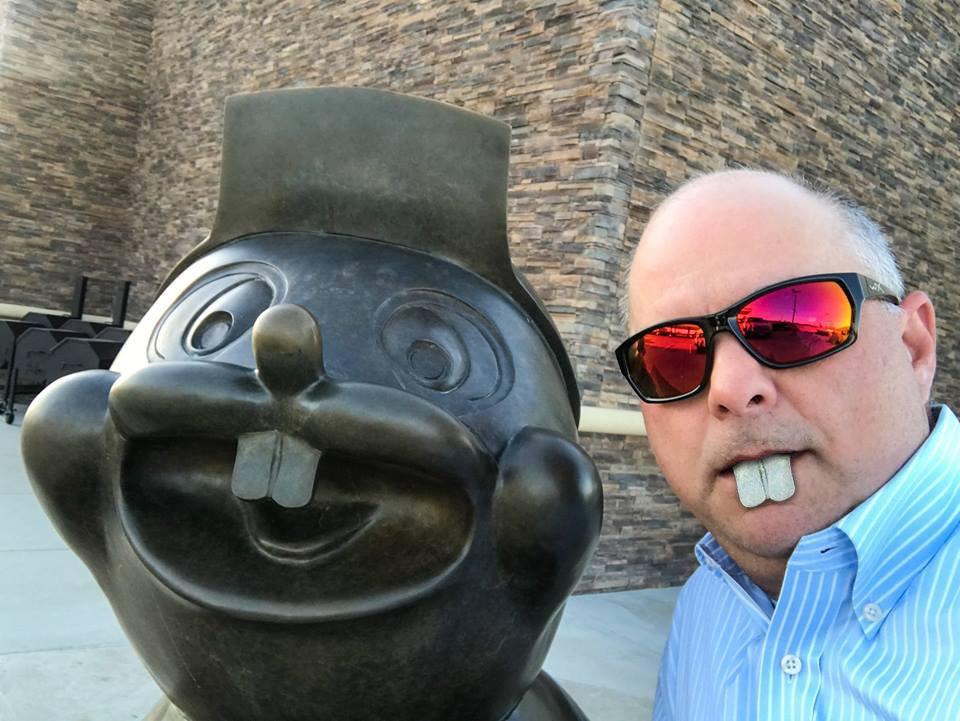
It started as a trickle. But it quickly became a tidal wave.
Jim Sutton was at home watching the news the night COVID-19 began to shift, for him, from a distant spectacle to very close reality. Sure he’d heard about COVID in the weeks before. But Arkansas cases were spreading. A group, according to the newscast, traveling to Mardi Gras in New Orleans had returned to the Pine Bluff area and spread the virus. It was suddenly hitting home.
It was only within a matter of days, of course, that businesses shut down and employees scattered to their homes to work under unprecedented protocols. No matter how, why, or, where this all started, Jim realized in the coming days he and his IT department would be flooded.
It was up to them to stabilize the dam.
In “Gung Ho!” author Ken Blanchard leads the reader down a trail, to the edge of a pond circled by a narrow trail. It’s here where the two characters witness the tireless work of beavers, the pattern of work almost a mystery as each one worked independently, confidently, within their own space, to repair a dam.
“We fell silent and watched them go back to work. Working The Way of the Beaver: each in control of achieving the goal. Right work (repairs) being done the right way,” the book says.
When the dam broke, Jim knew it was up to his team to do their part in repairing it. To get themselves set up safely. To get customers back up and running wherever that may be. And to face this tidal wave with confidence.
“It did sort of start as a trickle,” Jim recalls. “Some customers were wanting to know how they can be set up from home. But all of the sudden, we came in one week and everybody wanted to know how to safely work from home. We really, really got busy there for a while.”
5 Steps for Stabilizing the Dam: How IT Took On the Tidal Wave With a Vengeance
Step 1: Take care of our own.
The very first thing Jim addressed was: What are we going to do for our own people? Very early on, it was decided to have IT work from home as much as possible.
Logistics included:
- Getting equipment home
- Establishing a remote connection
- Getting phones working from home to use the company’s phone system
Another big component to this was: How would managers manage the team remotely?
“Documentation is very important to us. We use it heavily to justify services to customers, to hiring people. Our ticket system is very important to us,” Jim said. “This time, it was different. So we really stepped up our ticketing system and began using different methodology. The documentation we utilized was for us to manage teams internally. To make sure we’re staying on top of activity, to see what people are doing, and get reports on utilization.”
Step 2: Take care of our customers.
When things were slowing down in other parts of the company, IT teams were going twice as hard as before.
Vice President of Strategic Technology Justin Huffaker says that 95 percent of Datamax IT Support is done remotely. Virtualized technology has become so prevalent that typically, the only need for onsite support entails delivery of equipment and when the team can’t connect to a client remotely.
But a tidal wave of requests like this? It’s anything but business as usual.
“The ticket load has doubled or tripled. That’s the biggest thing right now,” Justin said at the time. “Let’s say Datamax has 150 Managed Service clients. 150 clients are thrust into work from home at the same time. You get, not high tide, but a tidal wave.”
Tasks for Jim’s teams included:
- Setting up VPN or terminal servers for customers to work remotely
- Handling the laptops (and keyboards and monitors) requests that were pouring in
- Doing the research on and setting up the plethora of cameras for remote employees
What wasn’t difficult, for the most part, was managing these customers once they were up and running.
“The vast majority of our support is remote. What we would generally do, is we would set up equipment here, then send it off to the customer and they would distribute it to individual users,” Jim said. “Once the users got set up at home, they could call in a ticket, request help getting up, and we could issue a remote connection and take care of everything that way.”
Step 3: Take advantage of a seamless tech stack.
“All of our people are trained up on all of the solutions we provide to customers,” Jim said. “With our technology stack, when we engage with a customer to manage their network, there are certain solutions that we require customers to use for us to manage them.”
The big advantage this gave them? Continuity. Jim doesn’t have to guess who has certain capabilities on certain solutions. When customers needed access to work from home, all his people were capable of implementing what needed to be done.
“At that point, my job became mostly utilization, who was available, and how to best balance tickets. Distributing the load equally was much easier because of our consistent technology stack.”
Step 4: Take advantage of calculated cloud adoption.
For several years, Datamax’s IT division has made a huge push to get customers to the cloud. They’ve been busy retiring exchange servers, mail servers, and a lot of hardware to move people (at least partially) to the cloud. On implementing Office365. And educating on cloud collaboration tools that help employees work from anywhere they can get an Internet connection.
“Having people already in the cloud made it a lot easier for us during the entire COVID-19 scenario,” Jim said.
Step 5: Take it from Jim: Expect more of the same in 2021.
Datamax IT teams are still remote. While some have made their way back to the office, many of the customers are still doing the same.
“My viewpoint? This is the new normal. Over the years, there’s been a slow but steady move to working remotely … and this accelerated that movement tremendously. I don’t have plans or expectations that it’s going away,” Jim said.