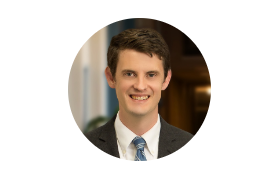
Robert Baker learned very early the art of being a chameleon.
Just as the lizard changes colors to match its surroundings, Robert – albeit out of necessity – discovered quickly how to adapt and mold his communication style to his ever-changing surroundings. With his dad working in the oil industry, he attended 13 schools in 12 years, moving all over West Texas, New Mexico, Oklahoma and beyond.
He graduated high school from a Christian school in Quito, Ecuador.
“One year, I was the new kid in school three times in one school year,” Robert says. “Moving around all the time like that, you actually had to develop certain communication skills. I didn’t like it a lot as a kid, of course. But I do believe it benefited me in my adult life simply because I was always meeting new people. Always introducing myself to people, making new friends. And I was doing this with people at all different levels – it could be teachers, staff or other students. That really helped me with my communication skills moving forward.”
The ability to acclimate to his surroundings pays off huge for both Robert and the reps he supports, as a solutions and production print specialist at Datamax in Tyler. Whether he’s speaking to IT specialists, copier technicians, executives or end users, Robert can speak their language. He can comprehend the complex and decipher in a manner that’s easy to consume.
Albert Einstein once said, “The definition of genius is taking the complex and making it simple.” Robert personifies that. His mastery lies not just in his Swiss Army knife’s equivalent of industry skills, but in his adaptability to his audience, and in his communication with people of all walks of life.
A Mastery of Skillsets
Early in his career, Robert pegged two possible points as professional destinations: 1. Canon, or 2. Apple.
“Simply put, I wanted to work for a manufacturer,” he says. “I tried to build my career path where I’d have the right set of skills and experiences to open that up. And it worked.”
But not before tacking on a plethora of other job skills.
After high school, even under the steady pressure from his father, Robert chose not to attend college. So his dad sent him to the jungles of South America to work in the oil field. It was there, working in a warehouse near Lima, Peru supporting rigs, that Robert began developing mechanical and welding skills.
After returning to the United States six months later, he framed and roofed houses while attending community college. He worked as a car mechanic and at a tire shop. At the age of 25, now with a wife and baby, he started school at Oklahoma State University, where he would earn a degree in Electronics Technologies.
“I started at the Mirex corporation in 1988. It was a great fit because I had component level circuit training, and I had a mechanics background. I did that for four years, then left that to work for Color Laser Graphix, the first business in Tulsa to produce color prints from a computer file. Later, I worked for Multi-Impressions Corp., owned by Graphics Universal, a Top 50 pre-press company in the US.”
Along the way, Robert developed a wide range of expertise on the entire print process, from beginning to end. These skills eventually led him down the career path of his choosing, as a systems engineer (and later a digital product marketing specialist) at Canon. Other job titles there included: Network Office Systems Specialist, Regional Filed Analyst and Technical Sales Executive.
A Mastery of Career Goals
His time at Canon would offer a lifetime’s worth of industry knowledge, and of rewarding experiences as he worked closely with sales representatives at dealerships literally from North Dakota to the southern tip of Texas. After roaming the red dirt of Texas and Oklahoma with a variety of “jobs,” he had reached his professional destination, in an industry he'd truly embraced.
As it’s been said before in this industry, the toner sort of gets in your blood.
“Cut one arm and you bleed toner. Cut the other arm and you bleed Canon,” Robert said. “The Canon product, without a doubt, kept me in in this industry. They just had an outstanding, superior product in my opinion – always have and still do. I wouldn’t trade my experiences there for the world.”
He came on board at a crucial time, helping Canon Dealerships and their reps through the transition from analog copiers to digital multifunction copiers.
“There was a lot of push-back from the dealerships,” Robert says. “At the time, the digital machines were incredibly more expensive than analog copiers. Trying to satisfy those objections with sales teams, to teach them the advantages of not having a printer, a copier, and a fax machine, but rather one centralized communication hub for the office, was difficult at first.”
Life on the road was tough as well. Out of a typical 22-day business month, he was on the road for 18 of those days. He would often wake up in a motel room and forget briefly what city he was in. But through the trials of daily travel, the perks came from seeing individual reps develop skillsets that made them grow.
“I recall one rep who, when I first visited the dealership, was driving an old Ford Pinto,” Robert says. “I watched him grow. I stayed involved with helping him gain knowledge and understanding of the business. And three years later, he was driving a Lexus. It wasn’t me that did that for him. But I was able to help him develop the right skills to find success.”
Even so, after 15 years with Canon and a career primarily on the road, Robert was looking for a ticket back home. He eyed a job with an independent dealership. Out of the 175 that he serviced at Canon, there were only three that he recalls he would even consider:
- One was a dealership in El Paso.
- One was Datamax.
- The other was then-East Texas Copy Systems.
Robert ended up at then-East Texas Copy Systems (now, of course Datamax) simply because, geographically, it put him near his aging mother and father. And he had a bit of the bug for East Texas.
“In college, I lived with my grandparents for a bit in Palestine (near Tyler),” Robert said. “And I just fell in love with East Texas – the dogwood trees, the rivers, the hunting and fishing. I always had a little Redneck in me… but I always said that one of these days I was going to retire in East Texas. I just didn’t know how exactly I was going to get here.”
A Mastery of Communication
From production print, to document management, to administrative support to simply tearing down a copier, Robert holds the expertise needed to support a sales rep under any circumstance. And no matter the solution or hardware at play, his mastery comes through his adaptability to whoever he finds himself in front of. To communicating the pain areas, the recommended solution, and the implementation pathway.
But it’s been suggested, perhaps rightly so, that Robert sells himself a bit short.
When he goes on a call with a new rep, he gives them the same speech every time. He’s the sidekick.
“I support the reps in any way that I can. When it comes to customer facing moments, I tell them ‘this is how this works when I support you: YOU are the superhero. I am the sidekick. I don’t ever want to be the superhero in our account… Your credibility is more important than mine with this account.’”
So there he is, as the sidekick, distilling complex information. Making potential recommendations. Supporting every move with every account he touches. Communicating the technical details in only the way Robert can.
It’s a gift, and a blessing.
“I’ve actually had people ask me how I do that.. how I make things that aren’t understandable understandable. And the answer is, I don’t know why I can do that. Maybe it’s a gift. All I know is you have to relate to people at their level, whether they’re a temporary employee or an executive. You have to speak at the level that you’re addressing,” Robert says.
“Best way I know how to explain it? To me, you have to be a chameleon.”