Bill James, the 'Father of Sabermetrics,' says that those who see the system as merely a collection of stats are missing the point.
Sabermetrics is the empirical analysis of baseball statistics that measure in-game activity. Stats like Wins Above Replacement (WAR), Weighted On-Base Average (wOBA) and On-Base Plus Slugging Plus (OPS+) carry significant weight in today’s team strategies and eventual outcomes.
“If you're looking at the stats for small advantages, that's not sabermetrics,” James said in a Tech Times article. “If you're using the numbers to try to represent the baseball universe and trying to understand what is actually going on in the game, that's what makes sabermetrics. You're trying to use the data to answer questions that are of interest to everybody, but which there's no other way to answer.”
It’s using the numbers to get a fuller understanding of issues (for example, how important is speed relative to power?) and – more importantly – applying those metrics to improve as a team.
The display monitors inside the ClientConnect Centers demonstrate that Datamax is an equally metric-driven organization. We use “Raving Fan” metrics like Response Time, Response + Resolution, First Call Completion and our average Recommendation Score to communicate relevant differentiators to our customers …. But also measure our own performance.
The numbers tell us the whole story.
“I’m a firm believer we’ve been successful because we react quickly when something happens. Having available metrics and reports and surveys keeps us well informed and keeps us on our toes when our customer needs attention,” Datamax Texas President David Rhodes said.
Like James, David is naturally analytical minded. Analyzing reports and spreadsheets regularly, he utilizes available metrics to see that department goals are being met, and any issues being resolved.
“I believe it starts with every person and every department needs a goal. Every position is valuable within our company. If you can set benchmarks and goals for tasks, then eventually the whole company will be successful,” David said. “We’ve embraced Roy Faries’ talents to come up with reporting of the progress of some of those goals. We’ve invested in software, namely BrightGauge, that takes those analytics and does a nice job graphing a visual view of our progress.”
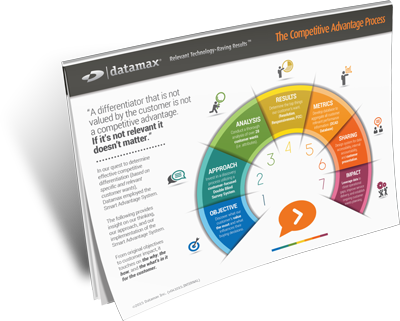
So what’s on the monitors?What are the issues most important to our customers? What is the essential data that needs to be collected? Those answers come in the form of our Competitive Advantage Program.
Defining the Metrics.
The Competitive Advantage Program ushered in a new era for the organization and revolutionized our perspective. With it, we stopped asking “what kind of company do we want to be” and started asking “what do our customers want?”
The metrics were a means for ensuring those customer wants were delivered.
Vice President of Marketing Robert Caldwell and a team of Datamax managers worked closely with Jaynie L. Smith and Smart Advantage, Inc. to conduct research to find out what it is our customers value, starting with a list of 28 attributes. These included qualities such as “provides accurate invoices,” “resolves issues quickly,” “able to repair copiers on first visit,” etc.
The findings?
The Top 3 Datamax Customer Wants:
- They said they want us to resolve their issues quickly.
- They said they want high speed response to their support/service requests.
- They said they want their equipment repaired on the first visit.
The Next 3 Datamax Customer Wants:
- They said they want their orders delivered accurately.
- They said they want us to provide accurate invoices.
- They said they want us to deliver their product and supplies on time.
“The results were pretty eye opening that, over all these years, the customer is still looking for the same thing. They’re looking for fast resolution (to service issues); they’re looking for billing accuracy,” David said. “And those are absolutely two key areas that we monitor on a daily basis.”
Evaluating the Metrics.
Metrics are not a stale entity. They’re a living, breathing thing that can swing two directions over time.
It’s up to managers to keep their eye on service performance, to communicate progress and to continually push for improvement.
A few elements that indicate our commitment to service performance are:
- Proactive Communication: When customers call for service, are they even speaking to a live person, at a local location? Can they expect proactive calls just to check in, to follow up and ensure that the client is up and running?
- Parts availability: Do technicians have the right parts in their vehicle PRIOR to dispatch? Or is it going to require a second visit because the right part is back at the office?
- Remote Device Management: Device-embedded tools can allow for the remote monitoring of devices, anticipating future service needs, automating tasks like toner replenishment and meter readings, and also give technicians direct access to device service data PRIOR to dispatch.
Bill James once joked, "I made baseball as fun as doing your taxes!" Baseball traditionalists may claim truth in that, as the game continues to pursue the most intricate of statistics to design specific lineups. But these same traditionalists can’t deny the stats' relevance ... or their significance.
There’s power in numbers.
“Assuming the input is correct, numbers don’t lie,” David said. “If we’re embracing our metrics and the goals we’ve established, and as an organization we’re actually performing as intended, word travels pretty well.”