Education is everything — especially to today's B2B buyer.
As a B2B professional, you may or may not be aware that educating your audience is a definitive way to gain more leads and conversions compared to flashy marketing techniques often associated with B2C strategies.
A visitor stumbles across one of your brand's social posts. They visit your website, view a few of your educational blogs, and find themselves at a content-gated landing page. They even fill out the form on the page, providing you their contact information.
Then, they go silent, failing to become a customer. That's unfortunate! But was all that work turning them into a lead a waste?
It doesn't have to be. B2B sales cycles can be long. So, just because they aren't ready to purchase right now, doesn't mean they never will. By creating a nurturing campaign using HubSpot workflows, we can continue to engage leads, keeping Datamax top of mind, and providing them the content they need to move closer to becoming a customer.
Step 1: Identify Our Audience
Before we can craft any campaign, we must first know your target audience. This starts by developing buyer personas. Buyer personas reflect our Datamax target audience. (A few at Datamax: Legal Lydia, Communications Carla, K-12 Kate, and Healthcare Helena).
A buyer persona is a semi-fictional representation of our ideal customer based on market research and real data about existing customers. Creating buyer persona(s), includes the following:
- Demographics
- Behavior patterns
- Challenges
- Motivations
- Goals
Step 2: Understand Our Buyer's Journey
To nurture a target audience with workflows, we must look at every stage of the buyer's journey. Below are the three stages of the buyer's journey, along with some context about how a prospect is feeling and what their goals are.
The awareness stage
The awareness stage of the buyer's journey is when people first become aware of their problem, or perhaps they're even unaware of their problem. Usually when a potential contact or lead experiences an indescribable discomfort, that is a good indication they face a challenge.
To solve for that discomfort, a potential buyer will try to better understand their challenge, its possible solution, and how to address either one. Thus, they're in the earliest stage of looking for answers to solve their problem.
So for this stage, focus on engaging unaware prospects and website visitors. This type of audience hasn't provided you with much more information other than how they interact in a minimal manner, such as coincidentally viewing one or two similarly focused blog posts on your website.
The consideration stage
The consideration stage of the buyer's journey is when people are clearly aware of their problem and are actively searching for solutions. While searching, they consider solution offerings from a variety of businesses and heavily engage with content that provides the most relevant and best answers to their problem.
Every action this audience takes, such as clicking a blog post or completing a quiz, can attribute to gaining more information about them. By also analyzing how your audience previously interacted with the awareness stage content, you can generally start segmenting them by sending relative pieces of content or assets.
The decision stage
The decision stage of the buyer's journey is when a person is just about ready to make a purchase. They're focused on finding a solution to their problem. So, what makes your brand and business the best solution?
Step 3: Create and Promote Educational Content
So now that we have a good understanding of the buyer's journey, here comes the fun part: creating content for each stage.
Awareness stage content acts as a foundation for website visitors to become leads. However, they first need to have some awareness of our brand and be able to engage with us. At this stage, we'll offer educational content that helps them identify what their problem or goal is and whether or not it's a priority. Just a few examples:
- Publish blog posts.
- Create social posts.
- Design an infographic.
- Promote an event.
- Publish an ebook.
Step 4: Design the Nurture Workflow.
To make sure our B2B lead nurturing email campaign engages with target audience(s) at every stage of the buyer's journey and your sales process, we must engage or re-engage them with appropriate workflows. "Workflow" is a marketing term that refers to an automated process where tasks, information, and emails are triggered based on set rules.
We can select conditions, then add email messages as steps. We can easily add as many email messages as we'd like to a workflow, set the amount of time we want in between emails (down to the minute), and analyze results as the information flows in.
Two recent Datamax Nurture Workflows:
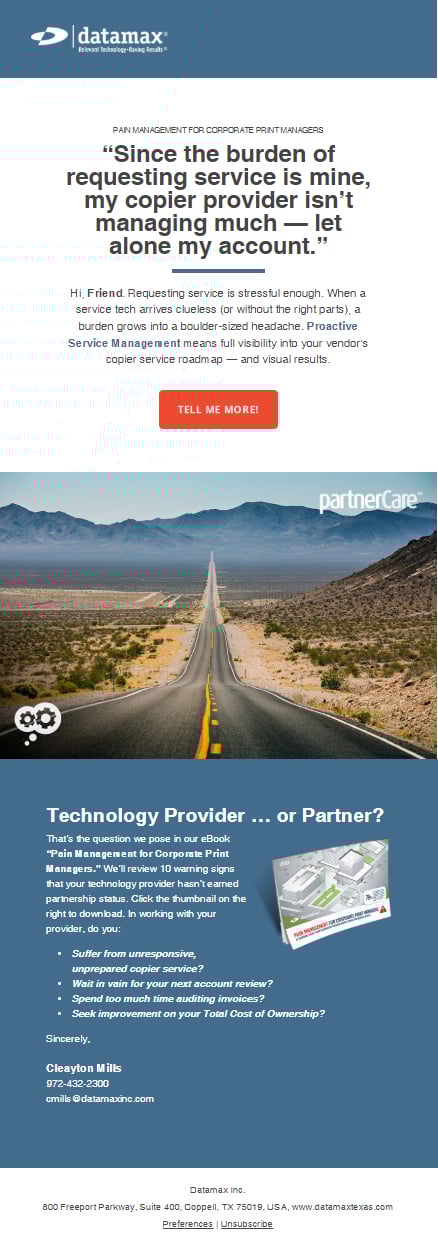
- Corporate Print Pain Management (Top 50): This email nurture campaign built for Texas includes a series of blog posts aimed at identifying specific, well-research pain points, and then providing RX for their pain. We also offer up our "Pain Management for Corporate Print Managers" eBook.
- CommCare Launch Campaign: Using whitepapers, blog posts, infographics, and our CommCare eBook as our value-added content, this campaign includes a series of 7 emails aimed to educate business people of both cloud-based phone systems and Unified Communcations as a way to streamline collaboration and communication.
Step 5: Witness World-Class Sales Prowess.
Marketing's participation at this juncture transitions, appropriately and graciously, to our world-class sales operation. It gives us marketers a front row seat to how business is really won: Belly to belly, face to face. And if we must ... Zoom to Zoom.