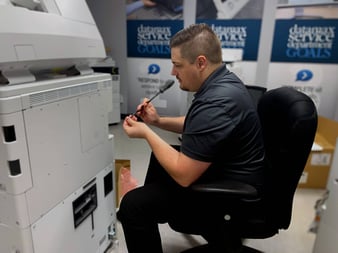
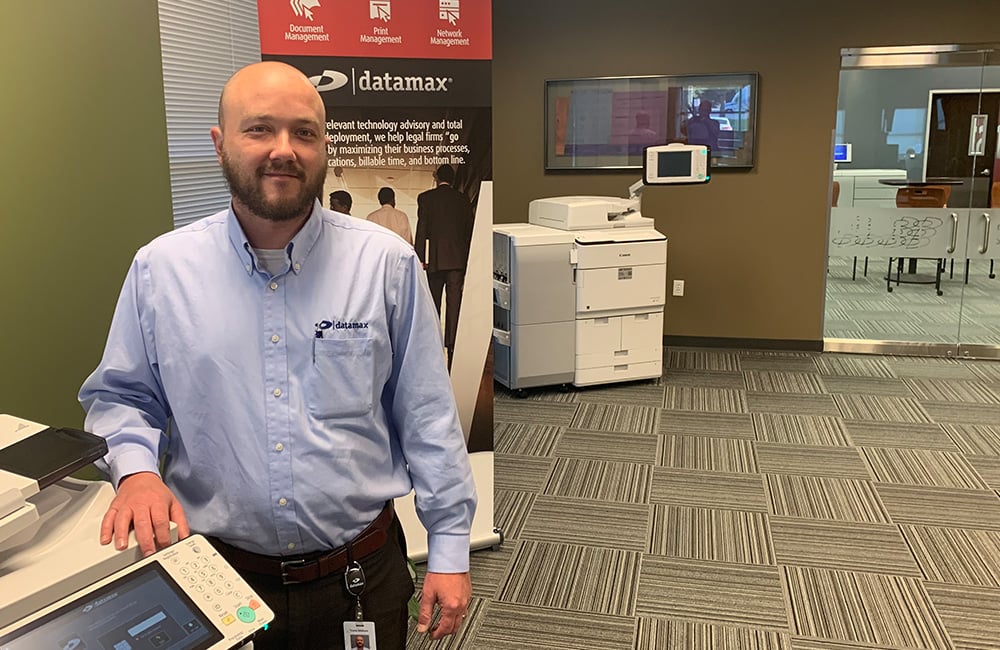
On the bottom floor of the Little Rock office, tucked inside the dispatch room, a great meeting of the minds has ensued.
A technician is stuck on a VoIP issue that is affecting a customer’s fax capabilities. Four supervisors, Tony Foust, Rodger Morris, Chris Williams, and Ken Miller, gather in a team-like huddle, thinking both mechanically and methodically. They ping and pong back and forth a variety of questions and suggestions for the tech. The conversation goes on for 15 minutes or more. The completely unscripted trouble-shooting steps start from the very beginning of the issue and lead to what they hope is a viable solution.
These few minutes illustrate these men aren’t just technically savvy. They’re true thinking men.
The issue also illustrates the definitive intersection between copiers and Information Technology in today’s office, and how these service professionals must constantly be adapting to the complexities of network and device-driven business workflow.
But at the moment, these guys are more interested in the basics.
“A lot of times, technicians, no matter their tenure, can get blinders on one machine. Our job is to say ‘OK, let’s take a step back, and go back to the basic qualities that all these machines share. Then we work forward from there,” Chris says.
For the service supervisors at Datamax, critical thinking and solving problems isn’t just in their job description – it’s in their DNA. From shadowing technicians, supporting the initiatives of managers and executives, and covering themselves up in mountains of data trends and manufacturer manuals, the reality is this: So much of what they do remains behind the scenes.
We simply wanted to shed some light on what your local service supervisors do every day. After talking to supervisors in Texas and Arkansas, here’s some of what we discovered:
Supervisors are superstar coaches.
Ken Miller, a Little Rock supervisor since 2014, has 7 technicians on his team. One of his main duties is coaching his guys up.
“I want to help teach them to be better troubleshooters. They might be on a call at an office 80 miles away and need help – I’m there to walk them through the logistical steps, and if we need to go deeper, we certainly will.”
Chris says, as a supervisor, you often “walk the tightrope between I can’t do it for you, but I can see you’re stumbling. Let’s work through this, and see if it’s something that’s fixable.”
Supervisors take calls, too.
When needed, these supervisors routinely provide support out in the field, assisting technicians or helping deescalate potential issues.
“I get to still live that technician life,” says DFW supervisor Quandre McCoy. “Even though I have people under me, I can still go out on service calls, and interact with technicians and customers. It’s sort of an all-in-one package. I love it!”
Quandre spent six years as a technician before being promoted, and says he still values every moment he gets to be out in the field.
Supervisors are often the “Catch-All.”
Tyler supervisor Michael Johnson has never been afraid to “tackle the unknown.” Because of this, the unknown is often precisely what comes his way.
“I get sent things I’ve never seen before in my life. Some people are intimidated by that, but I’m just like ‘OK – let's see what I can do,” Michael says.
Two examples: A dot matrix printer, which was released Michal was born; and an oil well log printer, designed to print a continuous feed of seismographs.
Supervisors do their research.
Supervisors are routinely looking at dispatch history in search of trends at customer locations, hoping to heed off bigger issues ahead of time. A perfect example? A recent Windows Update that disabled printing capabilities for many customers.
“If I am looking at the call history, and I start to see a pattern, we may need to dig a little deeper, this is going to be trouble down the road if we don’t address it now,” Chris said.
When techs call in, their supervisors regularly dig into Knowledge Base, a manufacturer support portal with a wealth of information at their fingertips, to troubleshoot remotely.
And they’re doing research on the technicians themselves. Technicians’ first call completion rate, parts usage, productive hours: These are all numbers that supervisors dig into regularly, but also communicate with their techs to constantly improve upon.
And then? Yup, time to coach ‘em up.
Supervisors go to great lengths for Customer Satisfaction.
Most people don’t know this about DFW Supervisor Curtis Whitlock, but he gives out his cell phone number to customers.
“I’m constantly communicating with customers after hours,” Curtis says. “It might be a simple question like, ‘how can I get this booklet to work?’ or after an install training, they may need extra help on adding something to an address book. I’ll walk them through step by step.”
After all, he says his biggest job? Keeping the customer happy.
Machines are ‘guilty until proven innocent.’
So says Little Rock supervisor Chris.
There are many moving parts to the technology surrounding a copier today. These often include email, phone system, and network-related issues that do affect the copier functionality.
“We are looked at as problem solvers. If it connects to the machine in some way, it’s our responsibility,” Ken says. “I do everything I can possibly do to make sure it’s not the machine causing the problem. And then, it’s important to be an excellent communicator in diagnosing and explaining the problem before trying to aide in resolution however we can.”
Supervisors are often the last line of resolution.
“When a certain issue arises, a tech might see something like this just once a year, but that’s what we’ve got to help figure out,” Rodger says.
A perfect example? The same one those four supervisors were collaborating on last month inside the dispatch office. The lines in the VoIP system, it turns out, have no voltage like analog fax lines have. Situations like this make it increasingly more difficult for the machines to recognize it has a fax, and the machine software is not keeping up with the fax industry.
Times change. Technology evolves. But the collaborative thinking continues.
When there are no manuals to turn to, no classes that cover a particular issue, these supervisors, teachers, collaborators and customer liaisons, are nothing but super at finding resolution.
.jpg?width=338&name=RR-Article-Smaller-Template-(Supervisors).jpg)