Is our buyer the central character in our story? Or do we still consider ourselves the hero of this journey?
After all, somewhere along the line, the story changed. It’s estimated by Hubspot that consumers go through 70–90% of the buyer’s journey before contacting a vendor. If we are to understand and support our prospective buyer, we must first realize that the journey for our customers and prospects is different today.
The key is this: Make each prospect and customer the hero of his or her buying journey. Prioritize the relationship, connect and empathize, identify and provide solutions to known and unknown business needs, and always remain focused on them versus on your company and/or the products being sold.
So what does the Buyer’s Journey look like today? Here are some insights from HubSpot on their interpretation of it.
Understanding the Buyer’s Journey.
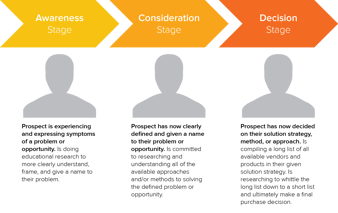
The buyer's journey can be broken down into three steps or "stages" that describe how they advance along their path to purchase: the awareness stage, the consideration stage, and the decision stage.
Here's how to conceptualize each stage:
- Awareness Stage: The buyer becomes aware that they have a problem.
- Consideration Stage: The buyer defines their problem and considers options to solve it.
- Decision Stage: The buyer evaluates and decides on the right provider to administer the solution.
Now that the overall journey has been defined, let's take a look at each stage in greater detail, from the buyer's perspective:
What is the buyer doing during the awareness stage?
The buyer is experiencing a problem or symptoms of a pain, and their goal is to alleviate it. They may be looking for informational resources to more clearly understand, frame, and give a name to their problem.
Example: "Why do my feet hurt all the time?"
What is the buyer doing during the consideration stage?
The buyer will have clearly defined and given a name to their problem, and they are committed to researching and understanding all of the available approaches and/or methods to solving the defined problem or opportunity.
Example: "How do you treat arch pain?"
What is the buyer doing during the decision stage?
The buyer has decided on their solution strategy, method, or approach. Their goal now is to compile a list of available vendors, make a shortlist, and ultimately make a final purchase decision.
Embracing The Buyer’s Journey.
With all of this in mind, buyers don't want to be prospected, or demoed, or closed when they're not ready. These steps add zero value, from their perspective, when offered at the wrong time.
However, where a sales rep can shine is in the instances when buyers are looking for additional information about your product that can't be found online. Embracing our Buyer (aka Hero) is about prioritizing the relationship, connecting and empathizing, identifying and providing solutions to known and unknown business needs, and always remaining focused on them... not us.
Making the Customer the Hero.
Put yourself in a buying position. You’re looking to purchase products that will increase your business’s production, thereby increasing revenue. But you need more specifics. Are you going to respond positively to a company or salesperson who:
- listens and empathizes with what you’re saying and recognizes your need?
- One who asks questions and focuses on you to solve that need in the most effective manner?
- An advisor who makes you feel part of the brand’s story, answers your questions with confidence, and closes by offering friendly assistance and a reliable sales experience?