Justin Huffaker's been around technical people since college. He knows the stereotypes that come with the territory.
He’s witnessed firsthand the frequent gap in communication behind highly-technical professionals and everyday employees. He knows that for many organizations, customer service trends are increasingly desensitized, dehumanized and highly automated. (Tried to get a live person when calling a bank, cable TV company, or Internet provider lately?)
And he knows that that level of customer service won’t cut it at Datamax. So he developed a system.
“I wanted to create a meaningful system for clients to communicate their satisfaction with our service. Some of the things you hear from business people regarding their technical support provider are: 'When I try to communicate with my technical support person, I don't understand the technical words they use' or 'when I send emails to my support group, I feel like my communication is falling into a black hole - I rarely hear back from them.'"
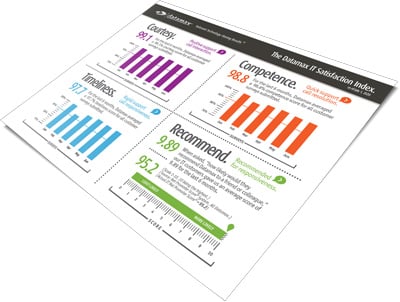
That’s why he created The Datamax IT Satisfaction Index.
How the Datamax IT Satisfaction Index Works:
The index is broken up into four categories for customers to rate between 1 and 5:
- Courtesy: Positive support call interaction
- Competence: Quick support call resolution
- Timeliness: Rapid support call responsiveness
- Recommend: Recommended for responsiveness
Historical field research has revealed the top 4 reasons why small and medium-sized businesses become dissatisfied with technology service providers and technical employees. This dissatisfaction often leads to termination of services/employment.
The Top four, based on our own research, are:
- Data loss
- Poor communication and customer service
- Technology down time
- Security breach
What is Justin investigating when he looks at the Satisfaction survey?
“One of the things I’m looking for is the aggregate score,” Justin says. “In our system, the maximum score in each rating category is five and a perfect survey score is to 20. If we received perfect 20 scores all the time, that would be great."
That, of course, is not always the case. Justin says a 17 is what he calls a “threshold survey,” one that he and managers will look at very closely. Clients who submit threshold survey scores will receive a phone call from one of the senior support team members to follow up.
Lower than a 17? A manager will contact that individual to see where we fell short, and to learn what we can do to make it a better support experience the next time.
Another element Justin is paying close attention to? The “Recommendation” score.
“A referral is very powerful. It’s the most tangible evidence we have that we are delivering on our promise to create Raving Fans,” Justin says. “When someone is happy and confident enough in the services they receive to add their name to a recommendation to do business with Datamax, we certainly value and treasure that.”
Justin’s Tech Coaching Tips: Keeping the Bar High on the IT Satisfaction Index
1. Recover the ‘Lost Art.’
It is quite common to hear people say that good customer service is a lost art.
In order for us to achieve the highest level of service, it's important to recognize that for Datamax, "good enough" doesn't cut it. Managers must set high expectations and front-line employees must deliver on our promise to create Raving Fans with every customer on every support call.
"We live in a time when customer support has been de-personalized. Have you ever needed help and gone to a specific company's website looking for a phone number? If you're like me, you want to speak to a live person and receive help in real time. However, for many companies, there are no phone numbers posted, only email or chat options are presented," Justin said. "That's certainly not the kind of support experience we want to provide. There are many technical people that prefer to communicate only through chat, text, or email; voice calls are avoided. New hires at Datamax are trained that we do not treat our customers that way. We want to actively communicate and develop a friendly, long-term relationship."
2. Get a mirror. Really!
“We encourage people to put mirrors in their cubes, to see what they look like while they’re talking to a customer. If they’re smiling, that smile comes through in their voice over the phone, and the person on the other end of the line can feel that. It’s about, what kind of demeanor are you projecting?” Justin says.
3. Hire diligently.
Justin has found that, here at Datamax, it will take managers three to four times longer to find a new employee on the technical support side then other companies.
"Being highly technical is not enough. We want employees who are very talented technically AND who can also communicate effectively and build relationships. A technical person who turns people off won't work out for us," Justin says.
4. Remember the important, humanistic metrics.
Metrics are important, certainly. Downtime, response, etc. are all numbers we value tremendously.
But when an average end user needs help doing their job, their most important metrics are patience, empathy, and sympathy. That’s one of the main reasons the Datamax IT Satisfaction Index was created – to provide quantifiable evidence that we’re delivering on our Raving Fan promise.
“We need people who relate to our customers. They need to effectively solve technical problems and be able to connect with people. They need to know that the Texas Rangers are a baseball team in the DFW area. They need to know that Arkansas is known for its beautiful outdoor living,” Justin says. “We need people who are well rounded, who can relate to our customers on a variety of topics, and not just throw technical buzzwords out as a means for conversation.”
With these items in mind, the surveys can and should take care of themselves!