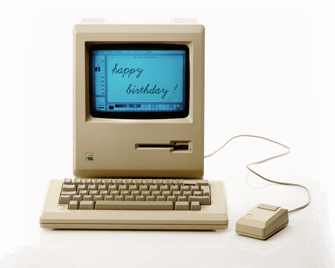
Brian James remembers that first Apple Macintosh Ad like it was yesterday. It aired during the 1984 Super Bowl. And it launched the course of his career.
The impact of that ad would reverberate across the technology industry in the days, weeks, and even months to come. People began to ask questions: What is this Mac? How is it different? A mouse? How is that going to work? Apple went onto to sell 72,000 computers in 100 days, twice as many as had been anticipated, after the ad ran.
He quickly learned: Apple had businesses covered moving forward.
“That ad really began to take the lid off the computing world,” James recalls. “For me, I was just finishing college. I still remember I would get chills – I said to myself, “I’ve got to get into this.”
And so he did. Operating a print shop after college, by utilizing the Mac and a laser printer, he was, doing twice the amount of jobs in half the time (and at a quarter of the cost). Brian pulled inspiration from an early Apple slogan, one that he still uses today at Datamax: “The power to be your best.”
Meanwhile, Vice President of Marketing Robert Caldwell was similarly picking the fruits of Apple’s ingenuity. In 1985, he started his second job and career finally aligned with his Marketing/Computer Information Systems degree from Baylor University.
"My first sales consultant position out of college was with Businessland, a San Jose, CA based billion-dollar value-add microcomputer/network provider. That was 1985 and the year Aldus introduced PageMaker for the Apple Macintosh ... and I was wholeheartedly hooked!!" Robert said.
Decades later, Brian and Robert were instrumental in the development of MaxCare - a Datamax branding initiative that communicates our company’s ability to support a business’s entire technology landscape through its family of technology support services.
Mac Desktop Publishing and the development of Datamax’s MaxCare: Even if it’s not exactly an apple to apple comparison, the concept is eerily similar. And that’s embracing a company’s power to be their best.
Desktop Publishing Covered
A publisher friend of Brian’s purchased a Mac soon after they were released, and the two began to play around with it day and night. Accustomed to a Commodore PC, Brian was blown away by the potential this new concept would bring to his company. A 3.5-inch floppy! 720K memory! A more intuitive way to typeset and produce publications!
“I stayed up nights and days learning it. I was having so much fun with it,” Brian said. “And the results (with his publishing company) were rolling in. So, Apple eventually said ‘you’ve got to come talk about this.’”
So Brian essentially went on tour with Apple. He would be introduced as a user, and he’d simply share his success story – someone who was really pushing the limits with a laser printer and the Mac’s capabilities, escaping antiquated ways of producing newspapers or trade publications and embracing the future.
In 1990, Brian opened Micro Computer Technologies, an Apple dealership that sold printers that would help other publishing companies make best use of the Macintosh. As time went on, he added Hewlett Packard and Compaq PCs.
He even hit the road, doing regular mobile demos out of his motor home.
“I was just loving it. We were growing 35 to 45 percent every single year. We had a good clientele, and I had an office conducive to demonstration,” Brian said.
IT Support Covered
Eventually, as personal computer sales began to commoditize, Brian was ready to move to the next level. He knew that, to do that, he’d need to be more service oriented.
“It was going to soon be the standard – the need of software service, maintenance and troubleshooting. You can buy this stuff all day long, but who’s going to support it?” Brian said.
It was about that time that, through one of his Apple customers, he met Barry Simon. Simon shared the changing landscape in copiers, moving to being network-connected devices.
“He said, ‘you wouldn’t be interested in selling your business, would you?’” Brian said. “And I was ready to take everything to the next level. So the next thing you know (in June of 2000), we merged."
‘We’ve got You Covered!’
After 14 years under the name Datamax Mico, Texas and Arkansas merged into a single Datamax entity. This brought the need bring similar unity to the list of support services.
Enter Robert Caldwell, Vice President of Marketing.
In attempts to unify the Datamax support brand, the idea of TechCare had already floated. So had LeaseCare and ImageCare. Brian, in his marketplace, had created the concept of “We’ve Got You Covered” and a strategy of what it represents.
“We actually had someone with the brilliance of Mr. Caldwell to take it to the next level,” Brian said.
Robert developed the MaxCare concept based on ideas and input. He constructed a diagram illustrating our family of support services, with the customer at the center and recipient of this comprehensive list.
“It was a demonstration of a company becoming unified,” Robert says. “When we were talking about components of what we do (in Texas and Arkansas), there was no longer a disconnect… likewise, we were telling customers we would minimize the number of vendors that they have to leverage. Same company, same invoicing, and from our perspective, it was a great opportunity to go deeper and wider with customers.”
In the End … it’s Maximum Coverage.
So what does MaxCare essentially represent for customers?
“If you’ve got a handful of vendors involved, when an issue arises they’re going to start finger pointing. And the customer is stuck in the middle. They’re the ones frustrated,” Brian says. “If you want the maximum return on your investment, MaxCare IS the route. You may have an agreement on your copier, your scanner, your IT services, but the bottom line is you can have a single company to support all of that.”
It’s comprehensive. It’s full coverage.
And when compared to so many competing technology support solutions, it’s hardly apples to apples.