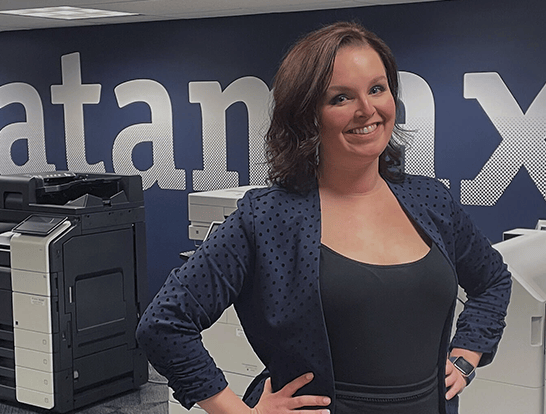
There’s a sign inside Linda Narcho’s office that reads “Bless this Nest.”
This DFW Sales Manager bears the name Mama Bird, and not because of the costume. It's because of the close-knit nature of her sales team. They grab lunch with one another regularly. Sometimes, they bring food back to the office and work through a deal as a group. They text back and forth over the weekends, and they spend five or 10 minutes every day sharing a laugh — a few moments that pay off in the long run.
Camaraderie is a great tool for cultural synergy, reasons Linda.
“It’s important to me that I keep my team close,” Linda says. “A positive, cohesive culture drives everything. It drives their success, their motivation, and their passion. We cut up and we laugh, and I’m Ok with that. It reminds them that they work in a high-energy company that wants them to be upbeat.”
As President Barry Simon mentions in his letter, “People leave managers, not companies.” As we aim to become culture champions, we look to our managers to create not only their own positive subcultures but a “culture of coaching” with their individual teams.
David Turner, CEO of Contegix, has created what he dubbed a “culture of coaching.” He shares his insights on a recently published eBook, “Why Company Culture Matters.” At least once a month, every single person in his company sits down with a leader or their manager to talk through things like:
- How they’re doing both professionally and personally?
- Are they confident with their professional development and career progression?
- How they’re finding pleasure with a purpose in their work?
- How healthy are their workplace relationships?
- Are they balancing work and their personal life?
- What is holding them back from doing more?
“It’s not a one-on-one. It’s not tactical. It’s not even about the company,” Turner writes. “It’s about how that team member is being engaged. How can their manager or leaders lead them to self-discover pleasure with a purpose in their work?
The question for managers is this: How can he or she lead employees to self-discover pleasure with a purpose in their work?
Kristen Finkbeiner believes strongly in real life, face to face communication.
So much so, that the Arkansas Administration Manager drives 11 hours or more a month to visit her team locations in Texarkana, Hot Springs, and Fort Smith.
“Having different offices, I wholeheartedly believe in face to face. Technology is great, but we are still humans that need that in-person interaction. How can I expect people to want to succeed if I’m not willing to go meet with them in person?” Kristen says.
She’s also a Birthday/Holiday fanatic. Her employees can expect a personalized Goodie bag or a lunch on her on special occasions.
“It’s just a genuine way to say thank you, you’re appreciated,” Kristen says. “A positive culture on my team is extremely important. The realities have been very different over the past two years. Without everyone being willing and jump in and support each other, I don’t know how else we would have made it .”
At the time of this interview, Ken Allison has just returned from lunch with his entire team.
He values these occasions. He knows their importance. Much like the times he takes them out to his Country Club for dinner, the time spent together outside the office is crucial for morale … and for culture.
“When we go to dinner together, it’s a time for us to relax, not talk about work, talk about the fun things in our lives; it’s time to enjoy each other’s company and connect on that individual personal level,” Ken says. “It’s incumbent on managers to build that excitement – a positive cohesive culture (on my team) is the most important thing. It’s up to me to set the stage for a positive work environment.”
Ken has his own ways of Coaching Culture Champions. Here are just a few:
- He starts by looking at his own actions. “Building culture starts with setting a good example … a lot of managing people and supporting them comes from building trust. If they trust you, they will follow you.”
- He caters his approach. “You can’t manage everybody the same. Everyone requires a different level of management.”
- He starts Mondays off on a positive note. “In our Monday morning meeting, I’ll start off by saying ‘tell me about your weekends.' People want to share what’s going on in their lives.”
In service meetings, East Texas Service Manager Justin Harper likes to borrow a phrase from President Barry Simon: 'The Best is Yet to Be.'
"I always make it a point to say that," Justin says. "That helps me push forward knowing that there's always more. When you think you're good, there's still great. When you think you're great, there's amazing. There's always that next step."
He also reminds his team regularly that when it comes to Datamax service in Texas, it's a single entity. This is further reinforced by the fact that Justin himself is spending the week in Dallas to help a shorthanded group.
"It's not Sulphur Springs or Tyler or Dallas. This is one single service team," Justin said. "Use each other, use your resources. If you need something we don't have, Dallas probably has it. We're all here to better the service experience for our customers."
"It's not about me." Lee Wheelington stands by that.
"It's not about me." It's the first words that Hot Springs Manager Lee utters at the start of this interview. Unintentionally (or intentionally!), he's hit on one of his key tenets of creating a positive subculture for his team: subservient leadership.
Lee tagged along with El Dorado Rep Keith Cook to visit a church recently. The pastor seemed surprised to be greeted by what he thought were two reps. "Lee's just being humble, he's my sales manager," Keith said.
"So he's truly a subservient leader," the pastor said.
"It's one of the greatest compliments we could receive as a manager, to be considered in that regard," Lee said. "My job is not to be the king. My job is to be the kingmaker. If you're going to talk about positive things happening with my team, I'd rather it be about my people moving the wheel."
Call it a nest. Call it subservient leadership, or call it face-to-face interaction. It's all about helping your team find purpose and pleasure in its work - coaching 'em up to be Culture Champions!