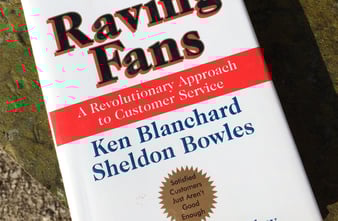
A satisfied customer simply doesn’t count these days.
It’s a hallmark line delivered in the opening chapter of “Raving Fans” by Ken Blanchard and Sheldon Bowles. Written in parable style, this brilliantly simple yet resonating story dives into defining and delivering a customer service model that’s truly worth Raving about.
After President Barry Simon picked up this book in 1993, it also helped motivate the Datamax mission statement of “Creating Raving Fans.”
“As I started reading that book, it just hit home. Then, when the book was published, and even today, people talk about customer satisfaction. That’s not what we wanted. We wanted ‘Raving Fans,” Simon says.
On customer satisfaction, Blanchard goes on to write:
“Your customers are only satisfied because their expectations are so low and because no one else is doing better,” Blanchard says. “You don’t own those customers. They’re just parked on your doorstep and will be glad to move along when they find something better.”
Just as creating an elaborate dish, the answers to “raving” customer service aren’t always in front of you. There needs to be a recipe. The recipe for companies looking to master their customer experience comes, via the book, as the three magic secrets of Creating Raving Fans.
Raving Fan Recipe: The Three Secrets to Creating Raving Fans, according to Ken Blanchard & Sheldon Bowles
1. Decide What You Want.
Have a clear vision of what you want your business to look like. Take the time to have such a clear vision of your business that you can walk through it in your mind as if it already exists.
“For us, we were always going to sell products that needed service ... this was where we knew we could build true value. We also felt it was imperative that our service people, and our sales people, were well trained in every way possible to Create that Raving Fan. It was never our intention to bring someone on board and start by saying ‘just do your job.’"
2. Discover What the Customer Wants.
Now that you have a clear vision of what you want, you need to alter it to what your customer wants. You do this by asking the customer what they want and then listen, really listen.
For Datamax, this meant digging deep into what our customers were looking for.
Vice President of Marketing Robert Caldwell and a team of Datamax managers worked closely with Jaynie L. Smith and Smart Advantage, Inc. to conduct research to find out what it is our customers value, starting with a list of 28 attributes. These included qualities such as “provides accurate invoices,” “resolves issues quickly,” “able to repair copiers on first visit,” etc.
A double blind survey, one in which neither the participants nor the experimenters know who is receiving a particular treatment to prevent bias, was performed to evaluate and define what essentially the customers want from a business technology provider. The survey included buyers and prospects from all across the United States.
What were the findings?
The Top 3 Datamax Customer Wants:
- They said they want us to resolve their issues quickly.
- They said they want high speed response to their support/service requests.
- They said they want their equipment repaired on the first visit.
The Next 3 Datamax Customer Wants:
- They said they want their orders delivered accurately.
- They said they want us to provide accurate invoices.
- They said they want us to deliver their product and supplies on time.
3. Deliver Plus One.
Once you know what you want for your business and what your customer wants in your business, you must deliver every time. This means always deliver the unexpected and always be evolving as your customer’s needs begin to change.
“A question I always get asked is ‘what’s our next product going to look like?’” Simon said. “I always respond with, ‘what have our customers taught us about what they need?’ What do they want in a technology provider?”
It comes back to that opening word of our tagline, “Relevant.” If it's not relevant to the customer, it simply doesn't matter.
- It’s about a holistic approach to business needs discovery supported by useful, expert consultation—not about a quick quote.
- It’s about developing and maximizing solutions that matter to our customers—not about just selling stuff.
- It’s about the customer and what they actually need— not about us, or assumptions of what we think they need.