Delivering value isn't a promise. It's a process.
Cody Simon knows this as much as anyone.
In his time in the field and supporting his reps today, he’s seen the pendulum swing in the minds of prospects. Just recently, a potential customer mentioned that they could get the equipment $1,000 cheaper online. Cody came back and explained all the price included: setup, training, toner, and overall expertise. He even agreed to drop the price, given that the client would set up and train themselves.
“He called back shortly after that and agreed to the original proposal,” Cody said. “I think they understood the commitment — it’s not just signing a deal and dropping off equipment. This is the culture we’ve built. We need to stay true to our mission — in the long run, that’s going to win.”
Benson Head, who’s been an Arkansas account rep for 7 months, is understanding the value process quickly.
“There’s nothing you can say about value. You have to prove it objectively,” Benson said.
But how do we prove it? More importantly, what does the process look like? Inbound Marketing methodology is represented by a flywheel, a model with three perpetual actions at work: Attract, Engage, Delight. These three stages of the inbound process aim to provide value and build trust.
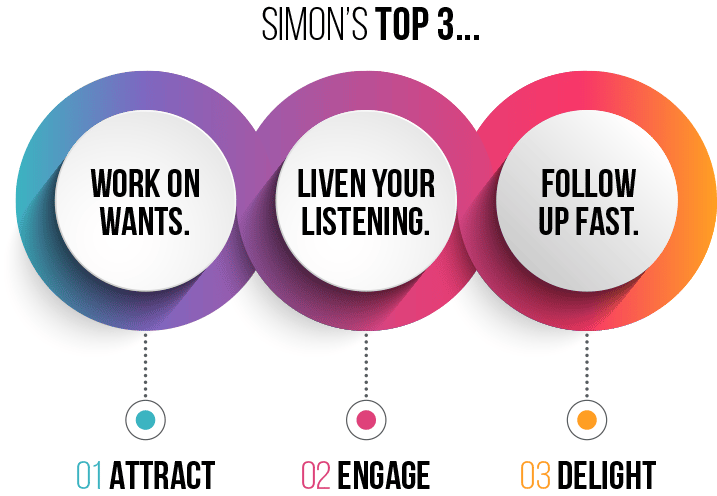
"Simon's Top 3" follows a similar model for value-driven sales, as you can see below!
1. Attract: Work on Wants.
When out in the field, Cody made this an extremely critical first priority. Some people will often start with price as the most important factor, but asking the right questions delivers further answers.
“You have to ask the question: What’s ultimately going to make you decide on these machines,” Cody says. “Whether it’s reliability, serviceability, certain guarantees in place, copy quality ... What’s important to them?”
Take it a step further, Cody says, and have the prospect rank them. What’s your number one priority? Number two? Etc.
2. Engage: Liven Your Listening.
This is a direct transition from no. 1. You’ve discovered wants and needs, but how can you prove to them how well you were listening?
A great place is in the proposal itself.
“When you go over the proposal, say ‘this is something we talked about. This is how we will work with that. You said that response time was a priority, here’s our average response and our average response + resolution time for the past six months,” Cody said. “The most important thing, to me, is making sure the customer knows we’re listening to them.”
3. Delight: Follow Up Fast.
Follow Up Post-Sale.
After you have ink, go over the installation process with the customer. Find out if there are any special instructions and make sure everyone internally knows what needs to be done.
Be there on install, or follow up quickly after one.
Follow Up With a Structured Partnership Review.
And then, conduct a Partnership Review.
“It’s here where you can say ‘OK, we’re off track on some things.’ ‘sure, we can do some follow up training here,’” Cody said. “I used to stop by clients all the time and ask questions and offer ‘here’s a neat trick’ on the equipment.’”
And make sure your visits with clients are pointed, purposeful.
“The last thing I ever want to do is waste someone’s time,” Benson says. “I make sure everything I do or say is pointed. Partnership Reviews are valuable to me because I’m setting them up in a position where they can succeed.”
And ... Don't Forget the Power of Pre-Sale Follow-Up.
"Following up pre-sale is a definite partnership litmus test," Vice President of Marketing Robert Caldwell said. "If you're not going to follow up hyper-responsively early on, it's certainly going to be questionable (in the prospect's mind) how the follow-up will be for the long term." Can you say #NOSALE?
Also, Robert warns, never underestimate the aggressiveness of your competition. Responsive pre-sale follow-up creates opportunities for providing answers, confirming capabilities, conveying best practices, or uncovering additional Discovery work that keeps the competition on their heels, or better yet, back at the drawing board.
"It's your opportunity to take initiative and to differentiate," Robert says.