The late Coach for the United States Military Academy, Homer Smith, once said: “Plays are precious; seconds are plays; therefore, seconds are precious.”
Clock Management – it’s critical. Coaches are often celebrated – or crucified – by how they manage the clock, particularly in the final minutes of any game.
Our service technicians, likewise, are always on the clock.
Every minute matters when it comes to satisfying our customers, and evaluating/sharing our Service Metrics. To succeed and to Create new Raving Fans, our technicians must be masters of clock management. What are our service metrics, how are these numbers watched, what do our technicians do to improve them, and why are these numbers so critical to victory?
Let’s discuss.
What are our Raving Fan Metrics?
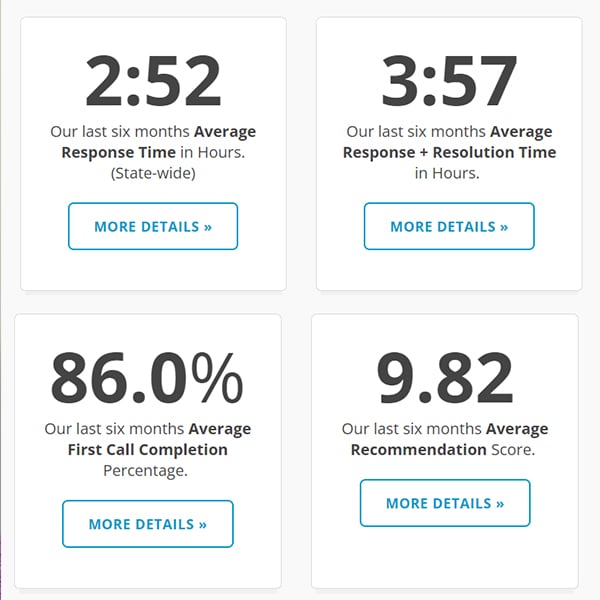
Raving Fan Metrics (i.e. copier service performance metrics) are essentially our way of showing customers exactly what they can expect from us, based on what matters most to them.
Realizing that preconceptions, assumptions, and blind spots, can inhibit a full and accurate understanding, a few years ago we engaged a nationally recognized consulting firm and their proven research process to identify the copier service metrics that matter most. Response, resolution, and first call completion were (are) undeniably at the top.
So using our Datamax Competitive Advantage Database (DCAD), we continuously track and publish Average Response Time, Average Resolution Time, Average First Call Completion Percentage, and our Average Recommendation score, among others.
How are our technicians measured? Response time, recalls, incomplete calls, gross calls, net calls, and parts per call are a few of the numbers that go into a technician’s report.
“At Datamax, we look at and report on this every morning in an executive huddle at 8 a.m.,” Texas VP of Service Steve Kennemer says. “This is to make sure that everything is on track for the day ahead.”
Watching the Clock: Four Ways Technicians Make Every Second Count.
1. They Record Every Play.
Our service metrics are entered (and measured) by running a service statistics report straight out of eAuto. This is the true raw data straight from the tech closing the calls out by using Mobile tech. Mobile tech is the technician connection to both eAuto and for Canon equipment SnapShot and Canon support.
“A technician’s dispatch times, arrival times, and the time that the machine is fixed… These are all calculated through Mobile Tech,” Arkansas Service Manager Mark McKinney said.
2. They Raise the Benchmarks.
Improvement is always the goal when it comes to our service metrics.
“You have to keep changing and updating your standard benchmarks to keep your teams moving forward. This is done by creating challenging competition between techs and teams. Implementing fun and different incentive programs for your technicians throughout the year,” Steve said.
One example: Texas has a program that recognizes technicians for each service survey received that includes a positive comment about the technician’s work. There is also an “over and beyond” incentive per week for one technician nominated for doing something that greatly exceeds one’s standard level of service.
3. They Know Resolution Reigns Supreme.
“One of the main differences with Datamax, and the way we look at metrics, is that we know what will make a difference with the customer. That is why we focus on resolution time over response time,” Kennemer says. “Anybody can get to an account fast. By monitoring all 7 metrics, Datamax is able to focus on quality, fast service, get the job done right the first time and make it last.”
4. They Remain Sharp With Time Management.
A technician’s success or failure, contends McKinney, ultimately boils down to time management. Without it, “it’s chaos,” he says.
“They have to manage time between getting to their first call as quickly as possible, manage their time in front of a customer and in front of the machine, they’ve got to also manage the time it takes to explain the issue and ‘fix the customer,’” McKinney says. “And then you take the next call and you do it all over again.”
Mark pores over the metrics reports every week that include total call volume, response times, and notes the tremendous importance (and pride he takes) in these numbers. But he also looks at the bigger picture: These metrics depend on how each technician performs when he or she is on the clock.
Plays are precious; seconds are plays; therefore, seconds are precious.
“If you have a great team who does their job, and you don’t have to worry about how they manage their time, those numbers will take care of themselves,” Mark says.