Anyone who knows Robert Caldwell – and has taken a peak at Datamax marketing collateral – appreciates his visual eye. But also, his holistic approach to multi-faceted marketing initiatives.
One must simply visit our websites to be struck by the imagery, to scroll downward, one element to another, absorbing our brand and our story with delight. Our domain serves as a preeminent part of sharing with online visitors who (and what) we are as an organization. But if websites carry the storytelling torch in today’s digitally-driven business environment, what’s our story?
In his TED Talk “Clues to a Great Story,” groundbreaking Pixar filmmaker Andrew Stanton outlined 5 key “clues” for great storytelling. One of those major talking points is “Be Intentional.” In other words, characters and narratives alike must be purposeful in their linear journey for us as viewers, or consumers, to really care.
In 2015, Datamax began the journey of establishing our new Web 2.0 domain, constructing two new websites (datamaxtexas.com and datamaxarkansas.com) inside the HubSpot platform. With a 2.5-inch binder in tow, and a head full of ideas for embracing a new era for buyer behavior, Robert was certainly purposeful in his approach.
It all started with HubSpot. This comprehensive platform carried the tools and the methodologies to introduce inbound marketing at Datamax.
“In approaching the website project, the question for such a multifaceted venture is, ‘how do you do this in a way that is cohesive, vs a mishmash of stuff,’” Robert says. “With the HubSpot platform, we brought in all the benefits of an elegant presentation of information, and were able to construct it in an organized manner that ultimately makes sense for the web visitor.”
For all its visual virtuosity, there were many distinct, intentional ideas in turning the pages in an ever-evolving Datamax digital story. Here’s five of them.
1. It must support the evolving buyers’ journey.
Robert and the executive team studied the stats on how the buyer’s journey had changed and how people we were using the Internet. Stat’s like this (compiled in 2014):
-
89% of B2B buyers begin their search for answers online.
-
They are over 57% through the buying process before they speak to your sales reps.
Everything from DVRs, spam software and certainly Google search were changing the ways consumers sought information on THEIR terms.
Inbound introduced a diversion from traditional, interruption-based marketing. But what is inbound? Inbound marketing is a business methodology that attracts customers by creating valuable content and experiences tailored to them. While outbound marketing interrupts your audience with content they don’t always want, inbound marketing forms connections they are looking for and solves problems they already have.
The inbound methodology consists of these three pillars:
- Attract: drawing in the right people with valuable content and conversations that establish you as a trusted advisor with whom they want to engage.
- Engage: presenting insights and solutions that align with their pain points and goals so they are more likely to buy from you.
- Delight: providing help and support to empower your customers to find success with their purchase.
Imagine a flywheel. Unlike a traditional sales funnel, a flywheel (continual attract, engage, and delight) produces perpetual motion and energy into the customer experience.
According to HubSpot, “Think about it: What happens to customers in the funnel? They’re the outcome — nothing more, nothing less. All of the energy you spent acquiring that customer is wasted, leaving you at square one.”
2. It must incorporate competitive advantage principles.
Several years ago, Datamax began the exhaustive task of creating a program that:
- Defines what it is our customers really value.
- Allows us all to clearly communicate a relevant message
- Tracks the data supporting that message to help us continually improve, and
- Builds customer confidence and keeps us competitive for the long run.
By identifying customer wants in a double blind survey, we then began measuring our performance on these key areas (service response, service resolution, first call completion, etc.).
Caldwell, with the help of Roy Faries and others, developed the Datamax Competitive Advantage Database (DCAD), which serves as a centralized/supporting competitive advantage data repository. This software, which updates statistics quarterly on each individual branch’s data on Response Time, First Call Completion, First Call efficiency and many other attributes, was designed to be easily sortable and reviewable internally.
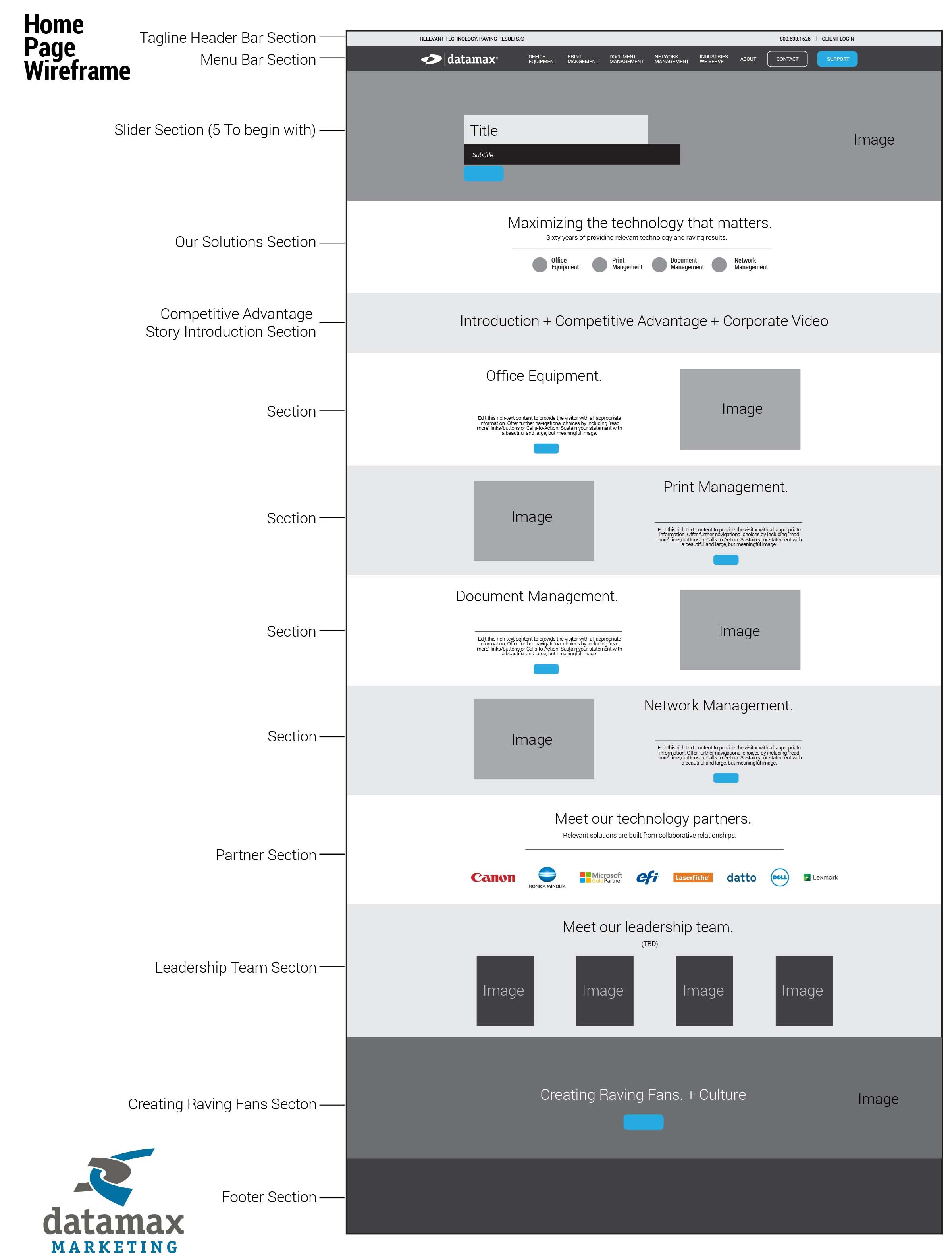
But these metrics are also intentionally displayed on the homepage of our websites.
“One thing’s for sure – we are committed to Competitive Advantage,” Robert says. “It was a big time must that we have our quadrants and Competitive Advantage information on the site. It was a really big deal not to have a bunch of “blah blah blah” on the front end of our website.”
3. It must be easily navigated.
One thing was clear to Robert regarding navigation: The support button shouldn't be missed. Customers should be able to find and submit service needs in an expedited fashion. That's why there's a clearly marked blue support button on the right side of the top navigation bar on our homepage.
Buyer behavior was certainly changing, but so was online behavior in general.
A website template that merely fit the dimensions of a desktop computer was no longer relevant. Users were surfing the web on tablets and phones at rapidly-increasing rates. Responsive design is an approach that suggests that design and development should respond to the user’s behavior and environment based on screen size, platform and orientation.
And it was imperative that the new Datamax sites adopt this approach.
“It was huge that our sites would render on all kinds of platforms,” Robert says.
In terms of navigation, a huge challenge for Datamax was communicating our multiple core competencies in an organized matter. How do you present a lot of information in way that’s not disparate?
One key way to address this was to create Pillar Pages for each competency – a page that’s broken down into subtopics with each briefly addressing important aspects of the main topic. These pages essentially tell a story. For an example, click here!
“Let’s say I have a customer that’s only interested in Document Management,” Robert says. “I can land them on a page and tell a story without them getting confused.”
Just last year, by collaborating with Production Specialist Grant Murray, Robert and Jeff completed a Production Print pillar page that presents 5 questions for print operators to ask themselves regarding their operations.
“We’re telling a story now,” Robert says. “We can fan off on specific equipment, we can find relevant blogs, and we can identify our point person (Grant) at the bottom.”
4. It must create an impression.
Recently, Robert and Jeff are putting the finishing touches on a Landing Page just last week, when Robert murmured something under his breath.
“I just really, really can’t stand images that aren’t relevant,” he said.
When one peruses our site, they don’t see a ton of copiers. What they do see are highly relevant images that either demonstrate the utilization of technology, or utilize creative imagery to make a memorable impact on the viewer.
This does, of course, create some challenges.
“Some people might say ‘I can’t tell what you do,’” Robert says. “And what I would say, is, ‘that’s an opportunity to tell them what you do. One of the things we wanted to say is ‘we’re a next level technology provider. We’re not just selling a copier, we’re selling our thinking: How we support technology, what we know about it, how we service it, and how we structure solutions.”
Robert, with his distinct visual eye, says one of the main things he wants to do with Datamax branding is create an impression. Something that someone would remember, or that would catch their eye. To avoid ever throwing up a “stock” image that a potential buyer’s seen a million times.
5. It must remain relevant.
A website is an ever-evolving, living, breathing entity that must be tended to often.
With the right training, the HubSpot platform affords the opportunity to adjust, update, and optimize on the fly. Last summer, as Datamax entered the Unified Communications arena, Robert and Jeff compiled a Pillar Page for this competency in a week. The team can dive in and tweak and design on their own, without needing a lot of help from the “outside.”
Robert says, given the substantial investment the company makes with HubSpot, he feels a strong responsibility to use this platform to its full extent.
“We use the heck out of it, and also in ways that it was not designed necessarily. For instance, The Rave Review: Originally intended to be an email sent out, we were able to take a creative approach on how we presented the eNewsletter,” Robert says.
The beauty lies in the ability to remain hyper accurate and hyper relevant.
“There are constantly things where we say ‘hey, that needs to change,’” he says. “And we can do it quickly.”
Going forward, we're never satisfied.
Andrew Stanton’s final “clue” to great storytelling is “Delight Me.” Don’t just entertain me. Thrill me, make me care and empathize in unexpected ways.
Ironically, delight is also the third step in HubSpot’s Inbound Marketing methodology. As customers continue their journey alongside Datamax, well after the transaction, we want to provide help and support to empower them to find success with their purchase, to continue to understand and to connect with our story.
The Datamax domain was established to do just that.
“The fact of the matter is that I’m proud of it, and I think it presents our company in a high echelon light. I feel great that we’ve continued to push the envelope in exploring all the capabilities that HubSpot has to offer.”
Then, Robert of course, looking at this living-breathing entity holistically, knows there’s more ahead.
I think we paint a good picture with this site. But I’m also never satisfied. I’m anxious to take it to another level.”